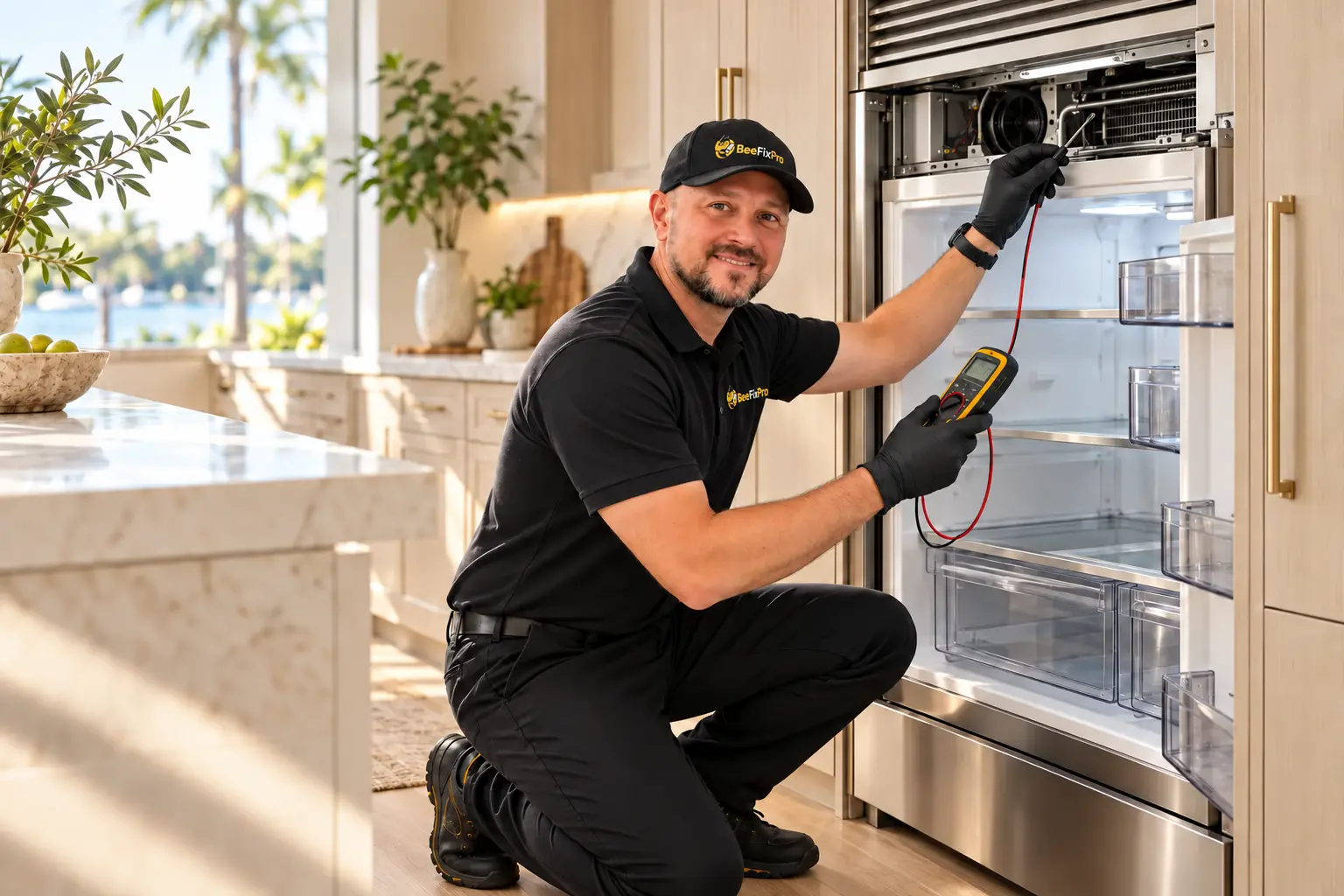
Premium brand repair · Jacksonville
Sub-Zero appliance repair
A clear guide to built-in refrigerator symptoms, careful diagnostics, maintenance, and the repair-or-replace decision.
The short answer
Luxury refrigeration needs an installation-aware diagnosis.
A Sub-Zero cooling complaint can begin with a familiar symptom—warm shelves, frost, noise, moisture, or slow ice—but the service path is shaped by the exact series, separate temperature zones, cabinet access, custom panels, and ventilation. A good visit protects the appliance and the kitchen around it.
Photograph the model and serial tag, note the displayed temperatures and messages, and describe which compartment changed first.
Built-in by design
Why Sub-Zero is not a standard refrigerator service call
Many Sub-Zero products are designed as part of the kitchen architecture: full-size built-ins, panel-ready columns, drawers, undercounter refrigeration, wine storage, and integrated ice systems. Removing or opening a service area may involve grilles, trim, cabinet reveals, water connections, and ventilation clearances that a freestanding refrigerator does not have.
Sub-Zero also uses multiple refrigeration architectures across current and legacy product lines. The manufacturer describes Dual Refrigeration on many Classic, Designer, and PRO products, allowing refrigerator and freezer sections to manage temperature and humidity independently. That benefit also means diagnosis must follow the exact model rather than assume every unit has the same compressor, fan, sensor, or control layout.
Integrated installation
Custom panels and cabinetry change access, removal, and reinstallation.
Multiple temperature zones
A symptom in one compartment may not describe what is happening in another.
Long model history
Series, controls, parts support, and condenser access vary across generations.
The useful starting point is the model number. It identifies the product family, component layout, service information, and the correct maintenance instructions.
Symptoms to document
What owners notice before a complete cooling failure
One symptom can have several causes, but the pattern helps organize the first tests. Record actual temperatures with the doors closed as much as possible, note whether the issue affects the refrigerator, freezer, or both, and save any message shown on the control panel.
Warm refrigerator or freezer
Airflow, a dirty condenser, fans, sensors, defrost operation, controls, sealing, and sealed-system conditions can overlap.
Runs almost continuously
High heat load, poor heat transfer, an open door, weak sealing, or reduced cooling capacity can increase run time.
Frost or moisture
Door alignment, gasket condition, humidity entry, drains, defrost components, and loading can change where moisture appears.
Slow or no ice
Cabinet temperature, water delivery, filters, fill components, sensing, harvest, and drainage all influence ice production.
New noise or vibration
Fans, ice contact, pumps, valves, cabinet fit, and compressor operation produce different sound patterns.
Door or gasket concern
Temporary resistance can be normal with an airtight seal; tears, gaps, condensation, or a door that will not pull closed are different.
Food-safety note: if storage temperatures are rising, move vulnerable food to safe cold storage and minimize door opening. Do not keep resetting the unit while the temperature continues to climb.
Diagnosis before parts
A careful Sub-Zero diagnostic follows the system
A high-value appliance deserves more than a part guess. The exact sequence changes by model, but a complete visit should move from evidence that is easy to verify toward tests that require deeper access.
Confirm identity and symptom
Model, serial, displayed temperatures, messages, recent service, and the first compartment affected establish the correct platform.
Check installation and heat transfer
Door closure, gaskets, accessible airflow, grille area, condenser condition, and cabinet clearances can explain or worsen the complaint.
Test operating components
Fans, thermistors, defrost components, switches, controls, valves, and ice-system functions are tested according to the symptom.
Evaluate the refrigeration circuit when indicated
Only after the earlier checks support it should the technician move toward compressor, refrigerant, leak, or sealed-system diagnosis.
A warm cabinet tells you where the problem appears—not which part failed.
BeeFixPro diagnostic principle
Product configurations
Built-in, column, drawer, wine, and ice systems
BeeFixPro works with many Sub-Zero refrigeration configurations, subject to model, installation, parts support, and safe access confirmation. Sharing the complete model number at booking helps match the visit to the right system.
| Configuration | Common concerns | Why the model matters |
|---|---|---|
| Built-in refrigerator | Temperature, frost, fans, defrost, water, ice, door sealing | Series changes access, controls, and refrigeration layout |
| Refrigerator or freezer column | Single-zone temperature, alarms, airflow, door alignment | Panel and adjacent-unit installation affect service access |
| Undercounter or drawer unit | Temperature, ventilation, drainage, control, gasket | Compact cabinetry changes condenser location and airflow |
| Wine storage | Zone temperature, humidity, noise, door, lighting | Zone count, shelving, and control design vary by family |
| Ice maker or ice system | No ice, slow production, leak, pump, drain, mineral buildup | Refrigerator ice makers and clear-ice machines use different systems |
A better decision framework
When repair makes sense—and when replacement deserves a look
There is no responsible universal repair percentage for a built-in appliance. Replacement can involve the refrigerator, compatible dimensions, custom panels, cabinetry, plumbing, electrical work, delivery, and installation. Repair can involve access, model-specific parts, and the condition of the rest of the system. Compare the complete paths.
- The diagnosis is isolated and the rest of the unit is in sound condition.
- Parts support is clear and there is no pattern of repeated major failure.
- The appliance fits custom cabinetry that would be difficult to replace.
- The written estimate is sensible against the complete installed replacement path.
- Multiple major systems are failing or corrosion and damage are widespread.
- The same expensive failure has returned after prior repair.
- Required parts are obsolete or support is uncertain.
- A remodel already changes the opening, panels, or kitchen plan.
A fan, gasket, control, ice-system repair, and sealed-system repair are not equivalent jobs. BeeFixPro diagnoses the actual unit and presents an estimate before approved work. See the service-call and pricing process.
Owner maintenance
The small routine that protects heat transfer
Sub-Zero recommends cleaning the condenser every six to twelve months, and more often when pets are present. Dust and lint restrict heat transfer and can contribute to longer run time or temperature loss. Because access varies by product line, use the instructions for the exact model and turn power off as directed before cleaning.
- 01
Use the model-specific guide
Grille, kickplate, filter, and condenser locations differ across Classic, Designer, PRO, legacy, and undercounter products.
- 02
Clean gently
A soft-bristle vacuum attachment is commonly specified. Do not bend condenser fins or apply unapproved chemicals.
- 03
Monitor, do not guess
After cleaning or changing a setpoint, allow the manufacturer-listed recovery period and watch actual temperatures.
- 04
Escalate a returning message
If temperatures do not recover or a service message returns, the unit needs diagnosis rather than repeated resets.
Northeast Florida coverage
Sub-Zero appliance repair near Jacksonville
BeeFixPro connects premium refrigeration guidance with local service pages across Jacksonville and nearby communities. Choose the nearest area, then review the matching refrigerator or freezer service before booking.
Brand service FAQ
Sub-Zero repair questions, answered clearly
Does BeeFixPro repair Sub-Zero refrigerators in Jacksonville?
BeeFixPro services many Sub-Zero built-in refrigerators, freezer columns, drawers, wine-storage units, and ice systems across Jacksonville and the connected Northeast Florida service area. Coverage is confirmed by model and installation.
Why is my Sub-Zero refrigerator running but not cooling?
A warm cabinet can involve airflow, a dirty condenser, fans, sensors, defrost components, controls, door sealing, or the sealed system. The symptom alone does not identify the failed part, so temperatures and operating behavior should be tested first.
How often should a Sub-Zero condenser be cleaned?
Sub-Zero recommends condenser cleaning every six to twelve months, and more often when pets are present. The exact access method depends on the product line, so follow the use and care guide for the model.
Is a Sub-Zero door that is difficult to reopen always broken?
Not necessarily. Sub-Zero explains that a temporary resistance can be normal because its products are designed for an airtight seal. A torn, hardened, misaligned, or non-sealing gasket is different and should be inspected.
How much does Sub-Zero appliance repair cost?
The total depends on the model, access, diagnosis, parts availability, and whether cabinet or panel work affects safe service. BeeFixPro diagnoses the unit and presents a written estimate before approved work.
Should I repair or replace an older Sub-Zero refrigerator?
Compare the diagnosis and written estimate with the age, overall condition, parts support, remaining manufacturer coverage, and the cost and disruption of replacing a built-in unit. The best decision is installation-specific rather than a universal percentage.
Brand found. Problem next.
Tell us what your Sub-Zero is doing.
Share the model, affected compartment, temperature, message, and when the symptom began. BeeFixPro will connect the details to the right diagnostic visit.