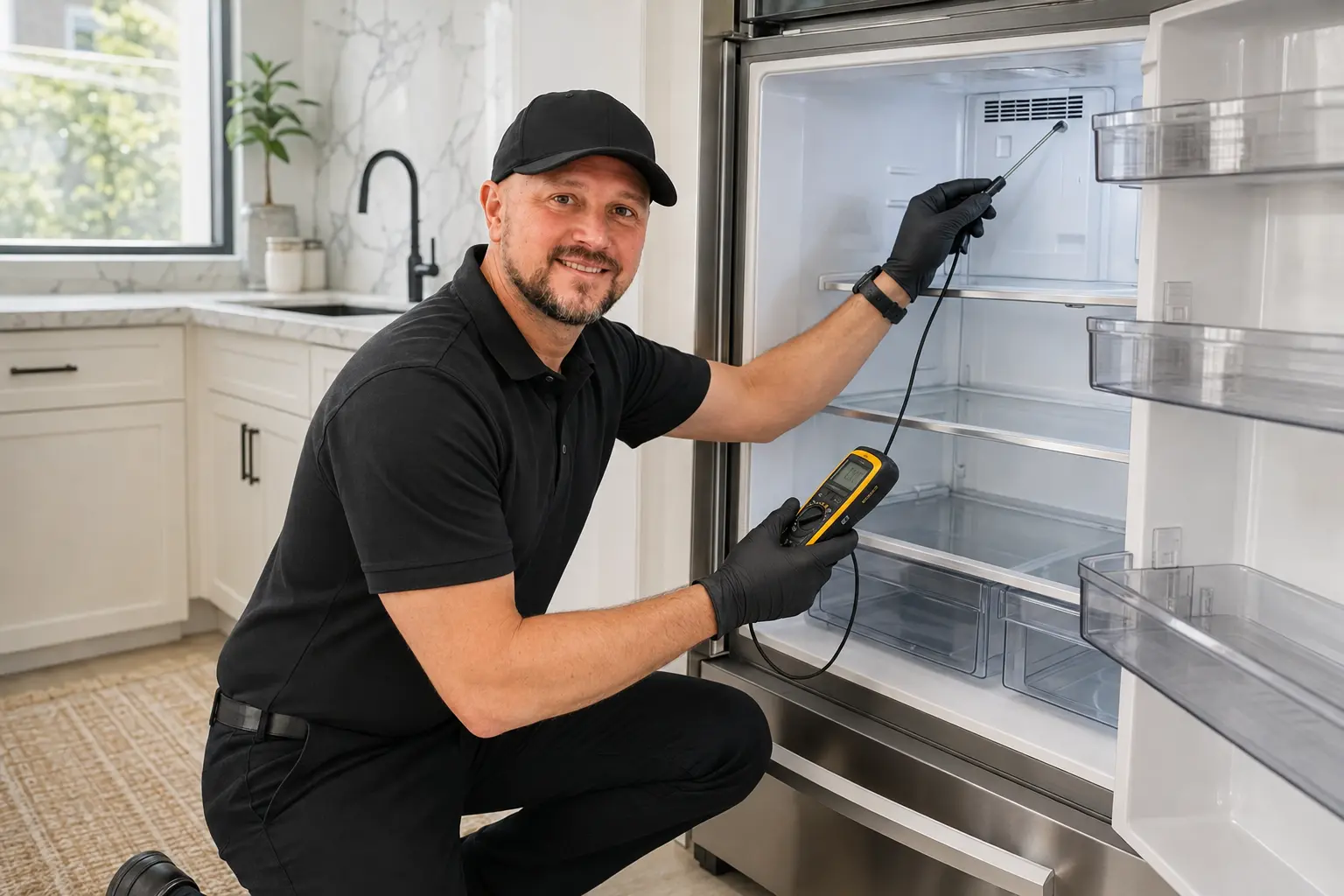
Refrigerator diagnostics · Jacksonville
Refrigerator Not CoolingA Technician’s Diagnostic Guide(with real repair costs)
The freezer pattern, airflow and compressor behavior reveal whether you are facing a focused repair or a larger sealed-system decision.
Quick answer
Start with one question: is the freezer still cold?
A refrigerator that stops cooling almost always comes down to one of five systems—airflow (the evaporator fan), the defrost system, dirty condenser coils, the start relay, or the sealed system/compressor. Which one it is hinges on a single question: is the freezer still cold? If the freezer works but the fridge is warm, it is an airflow problem, not the compressor—a repair that lands near $400 in our completed-job data. If both compartments are warm, you are looking at the defrost system, sealed system, or compressor, and the compressor is the only one that runs past $900.
Before you call anyone, read this. The most useful thing a technician does in the first two minutes of a refrigerator diagnostic is not touching the unit—it is asking whether the freezer is still cold. Your answer cuts the diagnosis in half. It tells us which system failed before we open a single panel, and it tells you whether you are looking at a $400 fix or a $1,000 decision.
The refrigerator is the single appliance BeeFixPro is called to repair most often—40.5% of completed jobs where an appliance was recorded, ahead of washers at 23.7% and dishwashers at 14.5%. That is 11,171 completed refrigerator visits, and the figures quoted throughout this guide come from that book of work rather than from published averages.
Same-day diagnostic available.
We run a full diagnostic—coils, fans, defrost system and sealed-system pressure—before recommending any repair. The diagnostic fee is applied to the repair cost when approved.
Symptom map
Match your symptom to the likely cause
The quickest diagnostic split is the temperature pattern. Compare what the fresh-food section, freezer and compressor are doing before assuming the most expensive component has failed.
| What you notice | Where the diagnosis usually starts |
|---|---|
| Fridge warm, freezer still cold | Airflow problem—evaporator fan, blocked air duct, or ice on the coils. The sealed system is fine. Median $422. |
| Both warm, compressor running | Sealed system or defrost—refrigerant leak, failing compressor, or ice blocking all airflow. Needs pressure testing. |
| Both warm, dead silence at the back | Compressor not starting—failed start relay, control board, or a failed compressor. |
| Cooling but cannot keep up | Dirty condenser coils, poor ventilation, worn door gaskets, or a slow refrigerant leak. |
| Clicking every few minutes, no cooling | Start relay failing to start the compressor. Leaving it uncorrected can burn out the compressor. |
| Thick ice wall inside the freezer panel | Defrost heater or thermostat has failed. It will recur in 1–4 weeks without a repair. |
| Cooling normally, but no ice | Not a cooling fault at all—the ice-maker module, fill tube, or inlet valve. Median $415; see our full ice-maker repair page. |
First diagnostic split
Step 1: read the symptom before touching anything
Before assuming a part has failed, confirm the correct refrigerator temperature is actually set. A bumped dial or a setting knocked during a grocery reload explains more warm-fridge calls than any failed component, and it costs nothing to rule out.
Once the setpoint checks out, there are really only four presentations of a refrigerator that “isn’t cooling”:
1. Fridge warm, freezer still cold
The freezer works perfectly—there is ice, frozen food is solid—but the refrigerator section is 50–60°F instead of 37°F. This pattern almost always means one thing: air is not moving from the freezer into the fridge section. The compressor and sealed system are fine. The problem is airflow.
- Failed evaporator fan motor (fan in the freezer that pushes cold air through)
- Blocked air duct between freezer and fridge (often from ice buildup)
- Defrost system failure causing ice to block the evaporator coils
2. Both warm, compressor running
You can hear or feel the compressor running at the back. The unit has power. But nothing is getting cold. This pattern points to the sealed system or the defrost cycle. Either refrigerant has leaked, the compressor is failing, or a defrost-system failure has let ice build up so thick it is completely blocking airflow to both compartments.
3. Both warm, compressor not running
Dead silence from the back. The compressor is not starting. This is either a failed start relay (a small, inexpensive part), a failed compressor (expensive), or a control-board issue sending no signal to start the compressor.
4. Both slightly warm, running constantly
The unit is working but cannot keep up. Common causes: dirty condenser coils, poor ventilation around the unit, failing door gaskets, or a refrigerant charge that is slowly leaking.
Technician sequence
The diagnosis technicians run on every “not cooling” call
Condenser coils—first, always
Dirty condenser coils are responsible for a surprising share of calls, and this is the one safe thing you can check yourself. The coils are at the bottom front (behind the kick plate) or at the back depending on the model. When coated in dust and pet hair, heat cannot escape and the compressor overheats. Pull the unit out, vacuum the coils, leave 2 inches of clearance behind and give it a few hours. If it starts cooling, that was your problem.
Start relay—second
If your fridge is warm and you hear a clicking sound every few minutes from the back, this is almost certainly the start relay failing to start the compressor. The part itself is cheap—but it sits on the compressor’s live power terminals, so this is a technician job, not a DIY one. A technician confirms it in minutes and carries the part on the truck. Left uncorrected, a bad relay makes the compressor try and fail dozens of times a day and can destroy it.
Evaporator fan—third
Open the freezer. Hold a piece of paper near the upper vent—no movement means the evaporator fan is not running. Often it is seized from ice buildup around the motor shaft; sometimes the motor itself has burned out. Either way it is a straightforward repair once a technician confirms which, and it is the single most common part we replace on a cooling call.
Defrost system—fourth
If there is a thick wall of ice covering the evaporator coils inside the freezer wall panel, the defrost heater or thermostat has failed. Manually defrosting (unplug for 24–48 hours with doors open) will get it running again temporarily—which actually confirms the diagnosis. But it will freeze up again within weeks, so book the repair rather than repeating the thaw.
Sealed system / compressor—last
Only after ruling out everything above does a good technician open the sealed system. Compressor diagnostics require pressure testing with manifold gauges and EPA 608 certification to handle refrigerant. This is where the job goes from a roughly $400 repair to a $670–$1,330 decision.
Completed-job pricing
What each repair actually costs in 2026
These are medians from our own completed refrigerator repairs, not part prices. Each figure is the full invoice: part, labor and the trip. That distinction matters more than anything else on this page—a start relay is a $15 part, and the job it belongs to settles near $389.
| Repair | Median | Middle range | Jobs |
|---|---|---|---|
| Dirty condenser coils | $0 | Clean it yourself | — |
| Thermostat / temperature sensor | $386 | $340–$470 | 65 |
| Start relay / overload | $389 | $335–$460 | 24 |
| Defrost heater or timer | $395 | $350–$530 | 58 |
| Water inlet valve | $401 | $345–$510 | 54 |
| Evaporator or condenser fan motor | $422 | $365–$510 | 130 |
| Door gasket / seal | $484 | $375–$710 | 49 |
| Control board | $564 | $430–$700 | 78 |
| Compressor replacement | $956 | $670–$1,330 | 80 |
The pattern in that table is the whole decision. Every non-compressor repair sits in one narrow band—roughly $380 to $560—because the price is made by the visit and the labor, not by the part. The compressor is the only line that breaks out, at about two and a half times the rest. So the real question a diagnostic answers is not “which of nine parts is it” but “is this the compressor, or is it everything else?”
The broader service record
Across 6,862 completed refrigerator repairs where a part was actually replaced, the median invoice is $395, with the middle half falling between $318 and $508. Counting every completed refrigerator visit including diagnostic-only calls, the median drops to $295—which is why published “average repair cost” figures vary so widely. Ice-maker jobs sit just above that at a $415 median across 3,471 completed visits, broken out by failed part and by brand on our ice-maker repair guide.
Price lists that show “start relay $50 to $150” or “evaporator fan $60 to $120” are quoting the component alone, with no trip and no labor. Real invoices for those same jobs land near $389 and $422. If an estimate does not include the visit, it is not an estimate—and being told $60 on the phone and $400 at the door is how a repair turns into an argument on the doorstep.
Let the temperature pattern guide the test.
Our technicians carry common relays, fan motors and defrost parts on the truck. Most non-compressor repairs are completed same-day.
Decision framework
Repair vs. replace: the real decision framework
The standard rule—repair if cost is under 50% of replacement value—is a starting point. Here is the more complete version:
| Fridge age | Repair cost | Recommendation |
|---|---|---|
| Under 5 years | Any amount | Repair—likely under warranty anyway |
| 5–8 years | Under $500 | Repair |
| 5–8 years | $500–$800 | Get a second opinion first |
| 8–12 years | Under $400 | Repair if not the compressor |
| 8–12 years | Compressor job | Replace—math rarely works |
| Over 12 years | Anything major | Replace |
| Any age | Second major repair in 2 years | Replace |
That table is not theoretical. In our own book of work, 22% of customers quoted a compressor replacement decline it and buy a new refrigerator instead—and on an eight-year-old unit, that is usually the right call. Built-in and premium units are the exception, because the cabinet opening dictates the replacement model and the installation is carpentry: there a $1,300–$1,700 compressor job can still be the cheaper path.
One thing that changes the math significantly: energy cost. A refrigerator from 2010–2014 uses roughly 40–50% more electricity than a current Energy Star model. At average U.S. electricity rates, that is $50–$100 per year in excess operating cost—factor that into a repair decision on an older unit.
Age matters, but the compressor is the dividing line. A focused fan, relay or defrost repair usually makes sense well into the appliance’s life. A compressor quote changes the calculation—unless the refrigerator is built-in or premium.
Immediate next steps
What to do right now
- 01
Freezer cold, fridge warm
Check the evaporator fan. Open the freezer, hold paper near the upper vent. No airflow = fan problem. Expect a bill near $422—book a diagnostic and it is typically same-day.
- 02
Nothing cooling + clicking sound
That points to the start relay failing to start the compressor. It is a cheap part, but it sits on the compressor’s live terminals, so book a diagnostic—a technician replaces it same-visit before the constant restart attempts damage the compressor.
- 03
Nothing cooling + complete silence
Check the outlet first (plug in something else), then the circuit breaker. If those are fine, it is a control board or compressor—book a technician.
- 04
Cooling but struggling
Confirm the setpoint against our recommended fridge and freezer temperatures using a standalone thermometer, then pull the unit away from the wall and vacuum the condenser coils. Leave 2 inches of clearance at the back and 1 inch on top. Those two checks together resolve a meaningful share of “not cooling well” calls—if neither helps, book a diagnostic.
- 05
Manually defrosted it and it started working
The defrost system has failed. It will freeze up again in 1–4 weeks without a repair. Book a diagnostic before it fails completely—a defrost repair runs about $395 against $956 for a compressor.
A failed start relay that goes undiagnosed for two weeks—while the compressor tries and fails to start dozens of times per day—can burn out the compressor. A $389 job becomes a $956 one. A defrost failure ignored for six months eventually turns into evaporator-coil damage and refrigerant-line problems. The $99 diagnostic, applied to the repair when approved, exists precisely to catch the cheap problem before it becomes the expensive one.
Repair costs are not the same in every market.
The figures above are our national medians. Local conditions move them, sometimes by a lot—and we have published what our own completed jobs show in each metro we serve.
Coastal repairs run a $492 median against $396 inland.
Built-in units are 3.4× the national concentration.
GE dominates the local mix; median $368.
The warm-fridge, cold-freezer pattern in detail.
Detailed answers
Frequently asked questions
Cooling patterns, costs, urgency and recovery time—clearly explained.
01Why is my refrigerator not cooling but the freezer is still cold?
This is the most common pattern we see, and it almost always means air is not moving from the freezer into the fridge section—not a compressor problem. The usual cause is a failed evaporator fan or ice blocking the air duct between the two compartments. Across 130 completed fan-motor jobs the median invoice is $422, because the sealed system is never opened.
02Why is my fridge running but not getting cold?
If you can hear the compressor running but nothing is cooling, the issue is usually the sealed system or the defrost cycle: a refrigerant leak, a failing compressor, or ice built up thick enough to block airflow to both compartments. A technician confirms which with a pressure test before quoting—it is the difference between a $395 defrost repair and a $956 compressor job.
03What is the most common reason a refrigerator stops cooling?
Across our own service calls, refrigerators are the single appliance we are called to repair most often—40.5% of completed jobs with an appliance recorded. The top causes are dirty condenser coils, a failed evaporator fan, and defrost-system failures, well before you get to the compressor. The good news: those top causes are among the cheapest to fix.
04How much does it cost to fix a refrigerator that is not cooling?
Every non-compressor repair sits in one band, roughly $380 to $560, because the price is made by the visit and the labor rather than the part: thermostat $386, start relay $389, defrost heater $395, fan motor $422, control board $564. Compressor replacement is the outlier at a $956 median, with the middle half between $670 and $1,330. Across 6,862 completed refrigerator repairs the overall median is $395.
05Is it worth repairing a refrigerator that stopped cooling, or should I replace it?
Under 8 years old, repair almost always wins unless it is the compressor. Over 12 years, or facing a second major repair in two years, replacement usually makes more sense. The dividing line is the compressor: 22% of customers quoted one decline it and buy new instead. The exception is a built-in or column unit, where the cabinet opening dictates the replacement model and repair often stays cheaper.
06Why did my refrigerator suddenly stop cooling overnight?
A sudden overnight failure usually points to something electrical or mechanical that failed all at once—a start relay, the evaporator fan motor, or the control board—rather than a slow refrigerant leak, which degrades over weeks. Check that it still has power and that the freezer is cold, then book a diagnostic.
07Is a refrigerator not cooling an emergency?
For your food, yes—USDA guidance treats refrigerated food as unsafe after about four hours above 40°F. Move perishables to a cooler and book a same-day or next-day diagnostic. The failure itself is rarely dangerous, but waiting can turn a cheap fix like a failing start relay into a burned-out compressor.
08How long does a refrigerator take to get cold again after it is fixed?
Once the repair is done, expect roughly 2–4 hours to reach a safe fridge temperature and up to 24 hours to fully stabilize. If you manually defrosted it and it started working, that is only temporary—the defrost system has failed and it will freeze up again within one to four weeks without a repair.
 Dmitriy · Local technician
Ready for a full diagnostic?
A complete diagnosis is one appointment away.
We check everything—coils, fans, the defrost system and sealed-system pressure—before recommending any repair. The diagnostic fee is applied to the repair when you approve it.
- Complete cooling-system diagnostic
- Estimate before approved repair