Dryer diagnostics · Jacksonville
Dryer Not HeatingCauses and Repair Costs(2026)
A tumbler that runs without heat is usually a repairable, single-component failure—not the end of the machine.
Quick answer
Heat loss usually points to one failed component.
If your dryer tumbles but produces no heat, the cause is almost always a single failed component—most often a blown thermal fuse, and after that the heating element on an electric dryer or the igniter on a gas dryer. It is a fixable repair, not a dead machine.
Across 369 completed no-heat dryer repairs in our own records, the ticket ran $320 to $438, median $375, and the part itself is $5 to $60 of that—the visit and the labor are what you are paying for.
Check one thing first: the exhaust vent. A clogged vent is what blows the thermal fuse, and a new fuse will blow again if the vent is not cleared.
A dryer that tumbles but produces no heat is one of the most common appliance complaints in U.S. households. The load comes out damp, you run it again, it is still damp—and by the third cycle you are wondering whether the machine is broken or just broken-expensive.
This guide explains the actual causes, in order of frequency, with repair costs taken from completed jobs across Atlanta, Tampa, Jacksonville, Miami, and Charlotte.
A dryer that runs but does not heat is almost always a fixable, single-component failure—not a sign the machine is dying. The failure is usually mechanical or electrical, isolated to one part, while the motor circuit keeps the drum turning.
“Runs but no heat” really is the biggest single dryer complaint in the cited records: 439 of 1,748 completed dryer jobs, close to one in four (see our appliance repair statistics). Where a part was replaced, the ticket ran $320 to $438, median $375. Where it was not, 37 of those visits closed in the $75 to $99 bracket—the fault was found and cleared with nothing sold. Across all completed dryer work of any kind, the median was $327.
We can fix it today.
Same-day service in Atlanta, Tampa, Jacksonville, Miami, and Charlotte—most dryer-heating repairs are completed in a single visit. The $99 diagnostic is waived when you approve the repair, and every completed job carries a 90-day parts-and-labor warranty.
Symptom map
Match what the dryer does to the likely cause
A dryer that runs but does not heat is usually an isolated mechanical or electrical failure. The precise pattern—completely cold, briefly warm, electric or gas—narrows the diagnostic path before any part is condemned.
| What you notice | Where diagnosis usually starts |
|---|---|
| Tumbles, no heat at all—electric dryer | Blown thermal fuse or failed heating element. Check the vent first. |
| Tumbles, no heat at all—gas dryer | Gas igniter first, then the thermal fuse. |
| Gets warm but clothes are still damp | Partial element break or a restricted vent—a different diagnostic path from a total no-heat condition. |
| No heat returns weeks after a fuse was replaced | The vent may never have been cleaned—the clog is the root cause and keeps blowing the fuse. |
| Drum runs, no heat, breaker recently tripped | Half of the 240V double-pole breaker may have tripped: the motor runs on one leg while heat is on the dead leg. |
| Gas dryer: igniter glows but burner never lights | A weak igniter cannot trip the gas valve, or the radiant sensor has failed. |
Why the source shows two service totals
The quick-answer figure refers to 369 completed no-heat repair tickets. The broader complaint analysis includes 439 “runs but no heat” cases among 1,748 dryer jobs, including visits resolved without a replacement part. Keeping the two samples separate makes the pricing context clearer rather than blending unlike records.
Most common causes
Seven causes explain the no-heat complaint
1. Blown thermal fuse
The thermal fuse is a one-time-use safety device located on the exhaust duct inside the dryer cabinet. Its job is to interrupt the heating circuit if the dryer overheats—which it does permanently. Once it blows, it does not reset. The dryer continues to tumble normally, which is why this failure is so often misdiagnosed as a mystery.
Why it blows: almost always a clogged or restricted exhaust vent. When airflow is blocked, heat builds up inside the drum. The fuse blows to prevent a fire. If the vent is not cleared before the new fuse is installed, the replacement will blow again—often within weeks.
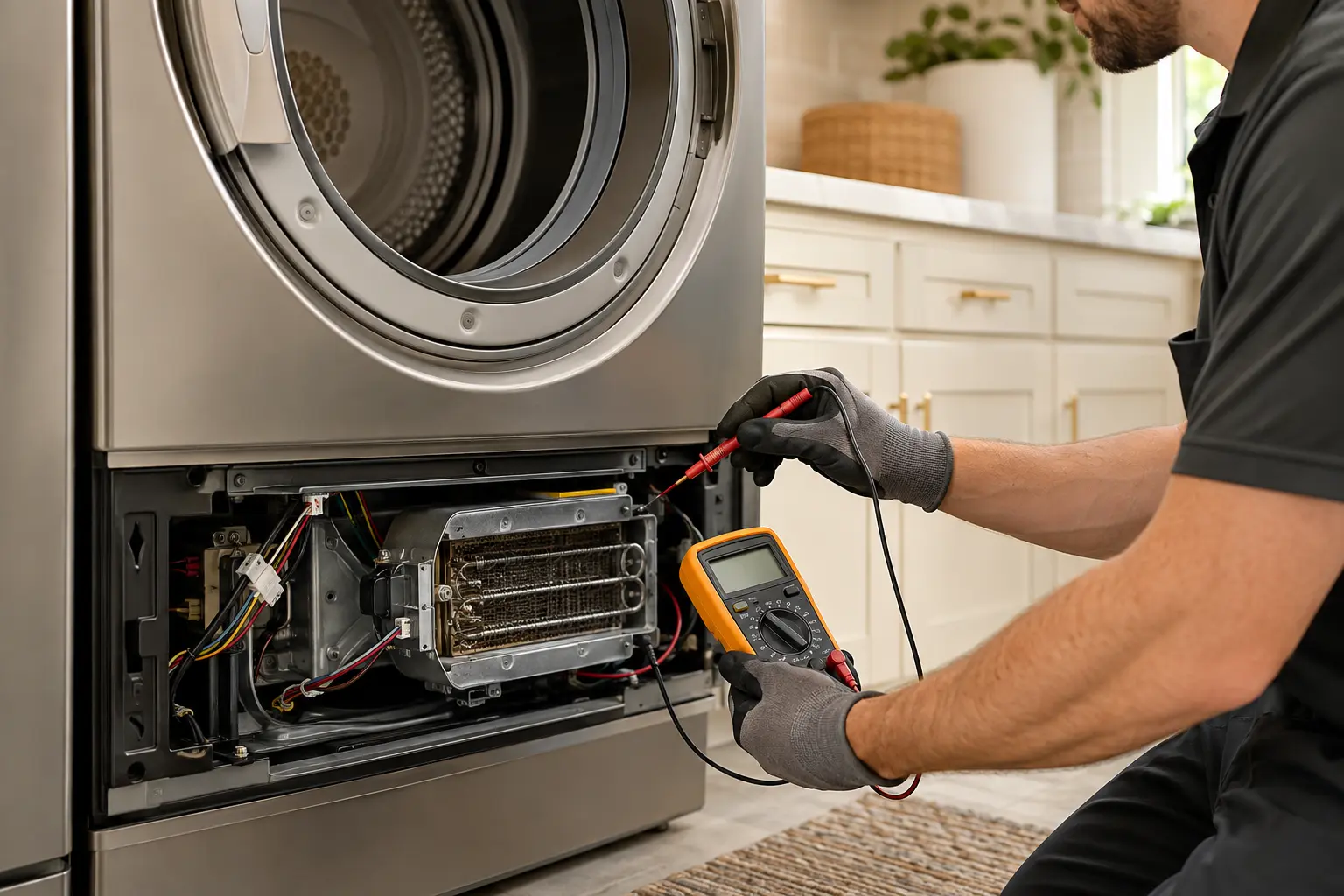
How it is diagnosed: a technician tests continuity with a multimeter. A good fuse shows continuity; a blown fuse reads open. The fuse is non-resettable, so it is replaced, and the vent is cleared during the same visit so the failure does not repeat.
A cheap part, but the visit and skilled labor set the invoice.
2. Heating-element failure
Electric dryers heat air by passing it over a coiled nichrome-wire element—essentially a large resistor. Over time, typically after 8–12 years of regular use, the coil develops a break and the circuit opens. The dryer tumbles but produces no heat at all.
Technical note: a partial break in the coil can produce reduced heat rather than no heat. The dryer runs but takes much longer than normal. If your clothes are damp after a full cycle but the dryer does feel warm, that is a different problem—see our guide on a dryer not drying fast for that diagnostic path.
How it is diagnosed: visual inspection for a visible break in the coil, plus a continuity test. A functioning element shows continuity; a broken element reads open.
The one repair on this page that is genuinely DIY-able: if your machine has rear-panel access and you own a multimeter, this is a job most people can finish in 45–90 minutes with a $20–$60 part. The full procedure, including how to meter the element before buying anything and why the vent has to be cleared at the same time, is in the heating-element replacement notes in this guide. If the drum has to come out to reach it, that is the point where most DIY attempts stall.
Source basis: 109 completed jobs, median $346.
3. Gas-igniter failure
Gas dryers use a glow-bar igniter to ignite the burner. The igniter heats to approximately 1,800°F to open the gas valve and initiate combustion. These igniters are fragile ceramic components that fail with age—they may glow but not become hot enough to trip the valve, or they may fail to glow at all.
How it is diagnosed: a technician opens the burner compartment and runs a cycle. If the igniter glows orange-red but the burner never lights, the igniter is likely too weak to open the valve, or the radiant sensor has failed—a common but often overlooked failure mode. If it does not glow at all, the igniter or its circuit is open.
Safety: gas components should always be handled by a professional.
The source had too few gas-igniter jobs to publish a separate band honestly, so they remain inside the general no-heat range.
4. Cycling thermostat
The cycling thermostat regulates temperature during normal operation. It opens and closes the heating circuit to maintain the selected temperature. When it fails open (stuck open), the heating element or burner never activates.
Important distinction: a failed cycling thermostat and a blown thermal fuse produce identical symptoms. Technicians test both simultaneously. The cycling thermostat, unlike the thermal fuse, is resettable in design—but when it fails mechanically it must be replaced, not reset.
Source basis: 31 completed jobs, median $350.
5. High-limit thermostat
The high-limit thermostat is a secondary safety device that trips at a higher temperature threshold than the cycling thermostat. It is designed to cut the heating circuit before the thermal fuse would need to blow. On many machines, it is mounted directly on the heating-element housing.
Unlike the thermal fuse, some high-limit thermostats are resettable—but most modern dryers use non-resettable versions. Failure is less common than the components above but more common than control-board failure.
The installed repair falls in the same price bucket as the cycling thermostat.
6. Clogged vent / airflow restriction
This is listed separately because it is not a component failure—it is a maintenance failure. A fully clogged vent can cause the dryer to overheat (the thermal fuse blows, stopping heat) or to produce heat that escapes inefficiently (clothes take two or three cycles to dry).
The U.S. Fire Administration reports approximately 2,900 residential dryer fires annually, and failure to clean is the leading cause. Beyond fire risk, restricted airflow causes component wear across the entire heating system.
- The lint trap (every load—always)
- The vent duct from the dryer to the exterior wall
- The exterior vent cap (birds nest in these; screens clog them)
- Duct material: flexible plastic duct is a fire hazard and should be replaced with rigid or semi-rigid metal
Vent and duct work in our records: $295–$450 (58 completed jobs, median $356), depending on duct length and accessibility.
7. Control board
Modern dryers with electronic controls have a main control board that governs heating cycles. Board failures that affect only heat output (with all other functions normal) are uncommon. In practice, a heating problem attributed to the control board without first ruling out every component above has probably been misdiagnosed.
That said, board failures do occur—typically on machines 7+ years old with electronic displays. If every heating component tests good and the wiring harness is intact, the board becomes the remaining suspect.
The one repair on this list in a different price class.
Failure mechanism
Why the drum can turn while the heat stays off
The motor and heating systems do not depend on exactly the same circuit. That is why a dryer can sound completely normal while producing cold air. Diagnosis follows the energy path instead of judging the machine by the spinning drum.
Half-tripped breaker
An electric dryer may tumble on 120V while the heater lacks the full 240V supply.
Restricted exhaust
Trapped heat can open the thermal fuse and shorten the life of a replacement part.
Gas sequence fault
Glow, sensor response and valve opening must happen in the correct order.
Clear repair pricing
Repair cost summary by cause
Part prices are retail. The right-hand column is not an estimate—it is the middle half of our own completed dryer jobs, covering the part, the labor and the visit.
| Cause | Part alone | Installed by a technician |
|---|---|---|
| Thermal fuse | $5–$15 | $255–$435 |
| Heating element | $20–$60 | $305–$404 |
| Cycling or high-limit thermostat | $10–$30 | $300–$382 |
| Gas igniter | $15–$40 | See no-heat band |
| Vent or duct work | — | $295–$450 |
| Control board | $100–$300 | $369–$612 |
| Any no-heat repair, all causes | — | $320–$438 |
| Diagnostic, nothing replaced | — | $99 |
The failed part can be inexpensive; the skilled visit is the repair.
Notice how narrow the installed-cost column is. Whether the failed part costs $5 or $60 barely changes the invoice, because the visit and labor dominate—which is exactly why confirming the diagnosis matters more than the price of the part. The control board is the only genuine outlier.
Let us diagnose it.
Our technicians carry the most common thermal fuses, heating elements and igniters on the truck—most repairs are completed same-day. The $99 diagnostic is waived when you approve the repair.
Safety-first checks
What you can check vs. what needs a technician
Four observations can narrow the problem before the visit.
- 01Lint-trap cleanliness
Clean the screen completely and make sure lint is not packed beneath it.
- 02Exterior vent cap for obstruction
Confirm the flap opens and that nests, screens or lint are not blocking discharge.
- 03Circuit breaker
Electric dryers use a double-pole breaker—one leg can trip while the other stays active, causing the motor to run but no heat.
- 04Gas-supply valve position
For gas dryers, verify the appliance shutoff valve is in the correct operating position.
If those are all fine and the dryer still will not heat, the problem is inside the heating circuit—and that is where a technician earns the visit. Diagnosing which component failed takes a multimeter and partial disassembly, and several of the failures (thermal fuse, high-limit thermostat and anything on a gas dryer) sit on the heat or gas circuit where a wrong move is a safety risk.
The parts themselves are inexpensive at $5 to $60; the value is confirming the diagnosis so you replace the right part once. We carry thermal fuses, elements, igniters and thermostats on the truck, so most no-heat calls are one visit.
Repair decision
Repair vs. replace: when to buy a new dryer
The general appliance-industry rule is straightforward: if repair cost exceeds 50% of replacement cost, replacement becomes worth serious consideration.
A basic dryer costs $500–$800 new, and a mid-range unit $800–$1,200, before delivery, installation and haul-away of the old machine. Against that, using the 50% threshold:
A $320–$438 repair sits comfortably under half the cost of any mid-range replacement—worth doing.
A $369–$612 control board on a machine over 10 years old warrants a replacement conversation.
A heating element and drum bearing failing together, for example, shift the math toward replacement.
Age matters more than cost alone. A 4-year-old dryer with a blown heating element (a $305–$404 repair) should be repaired without hesitation. A 12-year-old dryer needing a control board that has already had one prior repair is a legitimate replacement candidate.
Dryer lifespan averages 10–13 years. Machines by Whirlpool, Speed Queen and Maytag (under original ownership) have historically shown longer service lives in technician survey data. For a full breakdown, see the age-and-condition guidance above.
One visit. A clear decision.
Same-day dryer repair across Atlanta, Tampa, Jacksonville, Miami, and Charlotte. Most parts are stocked on the truck—one visit, problem solved. The $99 diagnostic is waived when you approve the repair.
Permanent correction
The repair path that prevents repeat heat loss
Restore the heat circuit—and correct what stressed it.
A durable repair verifies the supply, airflow, safety controls and heat source as one system. Replacing the open fuse without clearing the vent is not a complete correction.
- Confirm power or gas sequence
- Measure airflow and temperatures
- Test before replacing parts
Define the exact symptom
Record whether the dryer is fully cold, briefly warm or warm but unable to dry.
Verify supply and airflow
Check 240V power or gas ignition conditions, then evaluate the complete exhaust path.
Test the safety circuit
Measure the thermal fuse, thermostats and related controls before selecting a part.
Prove the repair
Run a heated cycle, confirm vent temperature and verify stable operation under load.
Detailed answers
Frequently asked questions
Everything to clarify before booking or opening the cabinet.
01Why does my dryer run but produce no heat?
The most likely cause is a blown thermal fuse, which interrupts the heating circuit permanently when the dryer overheats. The motor circuit is independent, so the drum keeps spinning normally. The next most common cause depends on dryer type: a failed heating element on electric dryers, or a failed igniter on gas dryers.
02How much does it cost to fix a dryer that is not heating?
Across 369 completed no-heat dryer repairs in our own records, the ticket ran $320 to $438, median $375, with the part itself only $5 to $60 of that. By component: heating element $305–$404, thermostat $300–$382, thermal fuse $255–$435. The one outlier is a control board at $369–$612. If the fault is found and cleared without replacing anything, you pay the $99 diagnostic only.
03Why is the labor so much more than the part?
Because the invoice is driven by the visit and the diagnosis, not the component. That is why a $5 thermal fuse and a $60 heating element land within about $100 of each other once installed. It is also the honest argument for doing the element yourself if your machine has rear-panel access—the part is the cheap half of the job.
04What is the difference between a dryer that will not heat and one that heats but will not dry?
No heat at all points to the heating circuit—thermal fuse, heating element or gas igniter. A dryer that gets warm but leaves clothes damp usually has a restricted vent or a partially failed element, which is a different diagnostic path. See our guide on a dryer not drying fast.
05Can I reset a thermal fuse?
No. Thermal fuses are one-time devices—once blown, they must be replaced. Bypassing a thermal fuse is a fire hazard and voids manufacturer warranties. Before replacing one, the exhaust vent must be cleared, because a clogged vent is the root cause in most thermal-fuse failures.
06How long does a dryer heating element last?
Typically 8–12 years under normal use (5–7 loads per week). Overloading the dryer, running it with a restricted vent, or consistently using high-heat settings accelerates element degradation.
07Is it worth repairing a dryer that does not heat?
In most cases, yes. A no-heat repair runs $320 to $438 in our records, well under the 50% replacement threshold against a $500 to $1,200 new machine plus delivery and installation. The exception is a control-board failure on a dryer already past ten years, especially one that has been repaired before.
08How do I know if my dryer vent is clogged?
Drying time increases noticeably (a load that used to take 45 minutes now takes 75+), the dryer exterior feels hot to the touch, clothes come out hotter than normal, or the thermal fuse blows repeatedly after replacement. Any of these indicates restricted airflow. Vent and duct work in our records runs $295 to $450.
 Dmitriy · Local technician
Ready when you are
Turn a cold drum into a clear repair decision.
Choose a convenient time online or call the Jacksonville team. We will confirm the visit and keep every next step clear.
- Electric and gas dryer diagnostics
- Estimate before approved repair